


Funny Tithing Video [video]
WARNING: I don't know which is worse: the disease or the cure!
(hat tip: Participatory Bible Study Blog)
Daily Read 01/30/2009
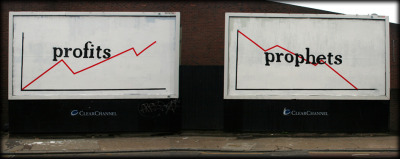
on the journey • profits / prophets
Court says school can expel lesbians - Feministing
- I don't know what to think: the injustice done to these girls, or the fact that the "Yes on Prop 8" people were blatantly lying. - post by umjeremy
- A private religious high school can expel students it believes are lesbians because the school isn't covered by California civil rights laws, a state appeals court has ruled.
ThinkGeek :: 3D Star Wars Starfighter Kites
Profit trumps preservation for Boy Scout councils nationwide
- This is terrible. My childhood merit badges are wilting... - post by umjeremy

Posted from Diigo. The rest of my favorite links are here. Read more...
Tyranny of the SEO Church
Following up on last week's post about Google's contributions to the Echo-chamber, I want to expand on one point:
What are the responses of Christian web ministries when their websites get less hits because people self-select "Saddleback" or "CrossWalk" and drive up their narrow viewpoints on the search lists?I started to think about this more. As more and more people turn to the Internets for answers, what if the top 10 hits on theological questions become the most read and thus the "standard?" Read on to see what the tyranny of a search-savvy viewpoint might become.
Wikipedia dominates Google Search results.This becomes more and more likely with the emergence of Google offering the top results in searches to Wikipedia. Nick Carr ran some google searches for a year or so and documented wikipedia entries moving into the top spot of those searches in a year's time. Should we worry about this? Maybe. (hat tap: Andrew Sullivan)
[W]hat we seem to have here is evidence of a fundamental failure of the Web as an information-delivery service. Three things have happened, in a blink of history's eye: (1) a single medium, the Web, has come to dominate the storage and supply of information, (2) a single search engine, Google, has come to dominate the navigation of that medium, and (3) a single information source, Wikipedia, has come to dominate the results served up by that search engine. Even if you adore the Web, Google, and Wikipedia - and I admit there's much to adore - you have to wonder if the transformation of the Net from a radically heterogeneous information source to a radically homogeneous one is a good thing.Hmm. While Wikipedia's mystique is of a huuge number of editors, a populist ideal, the reality (from our "What the Church can Learn from Wikipedia" series) is that a small number of editors really put together the pages. So, in other words, the top search result in Google isn't written by computers, but by small groups of Wikipedia gatherers and editors.
Is culture best served by an information triumvirate?
Is this bad? With any ownership of information by a small group of people, I would worry. I would worry about a group of evangelical Christians rewriting the Atonement entry of Wikipedia to be entirely blood atonement, which is not representative of all of Christianity, yet it gets top billing in Google.
Trouble brews when one party controls information.Jonathan Brink wonders the same thing on his post called "the End of Myth" where he describes how control of information (historically the Magisterium) begats myths to sustain that control:
The power of myth is essentially this: If I control truth, and you want to know truth, you need me. And if you need me, I can tell you what to think, how to act, and even where to give your money. I can even create visions of a hell that exists when you don’t follow me. I can in essence control you through fear. And when the cost is your soul, the weight gets increased exponentially. And worse, I don’t need to be right. I just need you to believe I’m right...See the relationship? For the Magisterium, they controlled information flow and propogated myth that reinforced their position. For Google, they control information flow, allegedly by computers, but wikipedia is clearly edited by a small group of humans.
Magisterium power lies in the control of information. To protect orthodoxy, the Magisterium essentially withheld Scripture from people, providing it in a foreign language.
Could theological viewpoints be search-optimized, or worse, buried?What it means to me is that any theological viewpoint that receives strong SEO (search engine optimization) can become the new "truth." If you can get that viewpoint to the top of google searches, or better to cover the majority of the first page of results, then that becomes more and more "truth." And this alliance between Wikipeda and Google can perpetuate this narrow viewpoint and bury (send to a lower ranking) theological viewpoints that do not agree with the SEO viewpoint.
I'm not wearing a tinfoil hat, this is happening today. Search for the United Methodist Church on Google and the Wikipedia entry comes up #1 (ABOVE the umc.org website! Seriously!). Thus the publicly editable website is above the UMC-written doctrine. But to the point: in the section on "beliefs on homosexuality" (click here), there's very little nuance of the doctrine. A UM friend of mine edited the section to better reflect the conflicting doctrines on this issue. Within hours, it was deleted and the monolithic viewpoint restored. This kept on for several days until the UM gave up. So, to any gay UMs wanting to see themselves in UM doctrine, they did not see it because of one or two people who kept reverting the UM Wikipedia article to its monolithic viewpoint.
The Tyranny of the SEO Church...what next?So, the tyranny of the SEO Church is that any theological viewpoint which receives higher status thanks to SEO efforts (either coordinated or consequential) becomes more "true" and read than opposing viewpoints. It doesn't become more true in fact or validity, but like the Magisterium, true in our belief that it is true.
Whew. Tinfoil hats on. I have more to write about this, but that's the gist. Thoughts so far to help me focus this conversation a bit? Read more...
Is Chewbacca in my nightstand? [video]
Only one way to find out: challenge the nightstand in dejarik. If you win and your arms are ripped off...then yes, it was Chewbacca.
[/nerd]
Fake News as Good News [Update]
 Some people try things out in their church and look for feedback online. I try out my crazy ideas online and use the feedback to make my local church ministry more awesome.
Back in November, I wrote about the effect a fake New York Times had on people and I wondered what would happen if we did something similar in the church: Using Fake News as the Good News.
Well, I tried it this past Sunday. Here's what happened.
Note: yes, there's a lot of "I" language in this. While the laity are very involved in worship, I made this a pastoral secret effort that surprised even the most well-connected of people. I would not recommend it, it was a lot of work!
So, there you have it. Questions about our experiment, or ideas you want to share about your own? Discuss.
Daily Read 01/23/2009
Would You Pay for Something if You Didn’t Have To? | Friendly Atheist by Hemant Mehta
- People who regularly attend service at church pay 22.1 cents less for the Sunday tabloid… This is a large effect, and we can only speculate with regard to its reasons. One reason might be that the church attendees lacked the coin money to make a proper payment. Active religious participation is high in the region, and on a typical Sunday morning it is plausible that many people might have donated some of their coin money to the church. Of course, this explanation does not change the fact that church attendees are particularly dishonest when paying for the newspaper. Another possible explanation is that the church attendees share relevant social traits. Gneezy (2005) found that honesty interacts with social preferences towards the person who benefits from one’s honesty. According to this explanation, a typical church attendee might believe that it would do little harm to the wealth of the publisher if he does not pay for the paper.


Posted from Diigo. The rest of my favorite links are here. Read more...
Subscribe to:
Posts (Atom)